
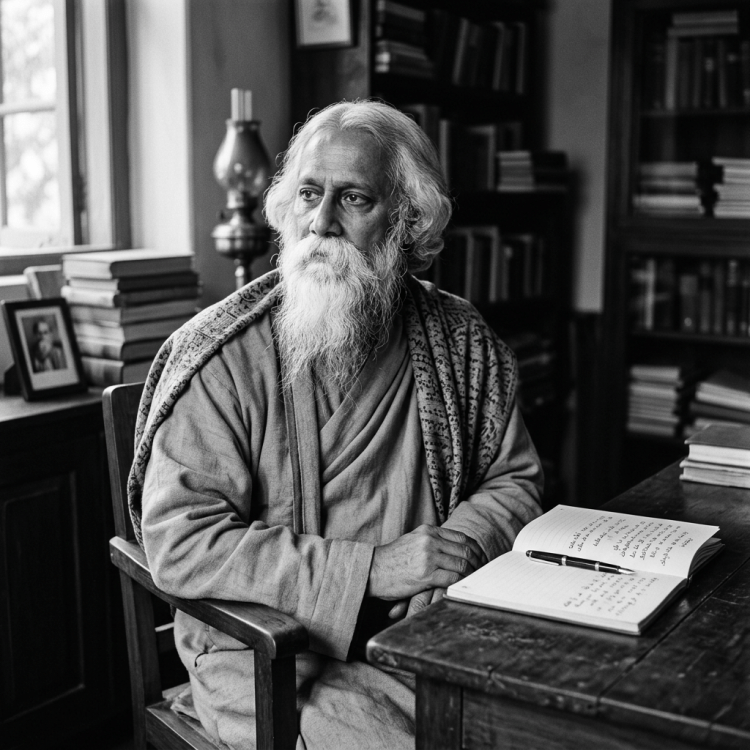
In the spring of 1929, a visitor attending a lecture in Honolulu encountered someone they would never forget: Rabindranath Tagore. Decades later, the memory remained vivid. It was not simply Tagore’s appearance that left such a lasting impression, but the extraordinary sense of serenity and spiritual dignity that seemed to radiate from him.
Others who met him felt much the same. One admirer in England described “the stately simplicity of his bearing,” while the Manchester Guardian wrote that those who saw him “will never forget his noble presence.” The artist William Rothenstein spoke of Tagore’s “inner charm,” and Jawaharlal Nehru later recalled the sadness he felt at knowing he would never again hear Tagore’s gentle voice.
What was it about Tagore that affected people so deeply?
Part of the answer lies in the rare harmony between his life and his ideals. He was not merely a poet writing about compassion, beauty, and humanity — he sought to live those principles in practical ways.
Compassion in Action
As a young man, Tagore managed his father’s estates and came into close contact with poor farming communities living in difficult conditions. Rather than distancing himself from them, he became deeply concerned for their wellbeing. He encouraged improved agricultural methods, studied medicine to help care for the sick, and made himself available to those in need at all hours.
This practical compassion became one of the defining characteristics of his life. His spirituality was not withdrawn from the world; it was expressed through service to others.
Tagore loved his homeland deeply, yet he resisted narrow nationalism. He wanted to awaken dignity and self-respect within his people without fostering hatred toward others. His patriotism was rooted in human unity rather than division.
In one of his patriotic writings, he urged his fellow countrymen not to burn foreign cloth, but rather “the inertia of centuries” — the accumulated habits and limitations that prevent human growth.
A Citizen of the World
When Tagore received the Nobel Prize for Literature in 1913, he became internationally known. Yet his universal outlook had existed long before fame arrived. He felt connected not merely to one nation or culture, but to humanity as a whole.
Wherever suffering or injustice existed, he responded with concern. He wrote and spoke on issues ranging from education and spiritual renewal to the dignity of women and the destructive effects of greed and exploitation. He condemned the opium trade in China and frequently warned against civilisations becoming intoxicated with power, materialism, and relentless ambition.
At the same time, he did not reject the modern world outright. Rather, he believed that outward progress needed to be balanced by inner wisdom.
During an address in Honolulu, Tagore expressed admiration for Western civilisation’s achievements, but also disappointment that cleverness and technical advancement were too often valued more highly than wisdom and moral insight. He encouraged people to take time, even briefly, to sit “at the feet of the great masters” and reconnect with the deeper dimensions of life.
East and West
In works such as Sādhanā, Tagore reflected deeply on the strengths and weaknesses of both Eastern and Western civilisation.
He felt that modern industrial culture often became so focused on outward achievement, expansion, and material progress that it neglected inner fulfilment and spiritual balance. Yet he was equally aware that parts of the East could become overly withdrawn from practical life and social action.
For Tagore, neither extreme was healthy.
The highest ideal was not withdrawal from the world, nor complete immersion in material ambition, but a harmonious balance between contemplation and action. Meditation and service, wisdom and creativity, inward peace and outward responsibility all belonged together.
This vision gave Tagore a unique voice during a period of intense political and cultural upheaval. He became, in the words of Mahatma Gandhi, “the Great Sentinel” — a moral and spiritual conscience speaking on behalf of humanity.
The Poetry of the Soul
Although Tagore was a philosopher, educator, composer, artist, and reformer, it is perhaps through his poetry that many people encounter him most deeply.
His celebrated collection Gitanjali expresses a spirituality filled with humility, devotion, and reverence for life. Beneath its beauty lies a profound longing to align human life with the Divine.
One passage captures the spirit that animated both his writings and his life:
This is my prayer to thee, my lord—
strike, strike at the root of penury in my heart.
Give me the strength lightly to bear
my joys and sorrows.
Give me the strength to make my
love fruitful in service.
Give me the strength never to disown
the poor or bend my knees before insolent might.
Give me the strength to raise my
mind high above daily trifles.
And give me the strength to
surrender my strength to thy will with love.
In an age often driven by noise, speed, and division, Tagore’s voice still speaks with remarkable clarity. His life reminds us that wisdom is not measured merely by intellect or achievement, but by the depth of one’s humanity, compassion, and inner harmony.

