What role do symmetry and balance play in our lives? When we dig deep into the subject, we find that these two aspects of our existence underpin everything from our environment to our physical well-being and even the mechanics of our entire universe. They may sound like concepts relevant only to the field of science or art, and yet they affect many experiences of living out our lives from day to day.
Symmetry means literally “equality of measurements,” that is, of size and shape. There are several different kinds of symmetry but the most common types are seen in nature. There are examples of symmetry in all three of nature’s kingdoms: mineral, vegetable and animal.
A remarkable symmetry is seen in mineral crystals such as diamond and quartz, or the starlike filigree design of powdery snowflakes. In the vegetable kingdom, the binary symmetry of orchids and the multiple symmetry of daisies or dahlias are well known.
In the lower forms of animal life, we find multiple symmetry in starfishes and sea urchins. In humans, and in the higher categories of animal, symmetry conforms to the bilateral type exemplified by twin eyes, ears, nostrils, hands, and feet. The prevalence of symmetry in living beings has impressed itself so deeply on the mind that in aesthetics, symmetry is often associated with beauty.
Mystical Symbols
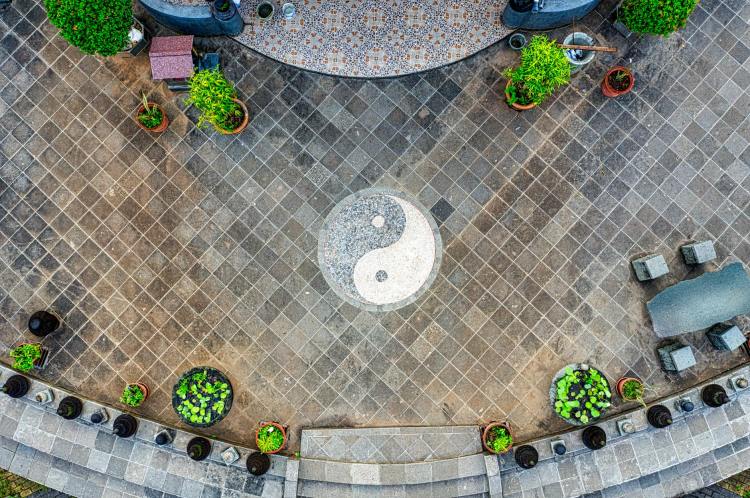
Symmetry is also a mathematical term. In geometry at school, we may have studied such symmetrical figures as isosceles triangles, pyramids and diamonds. Mystically, symmetry is important. The basic symbols, triangle and cross, are both symmetrical figures, representing the interaction of two equal forces. In most cases these equal forces are opposite poles so that one may regard their interplay as a process. This view is beautifully symbolised by the Chinese figure of Yang and Yin, the intertwined symbols that together form a perfect circle.
The circle with a point at its centre is a profound mystical symbol with diverse meanings. It can represent a cell with its nucleus, but also the polar interrelation of microcosm and macrocosm, or a single human being and the universe. From a geometrical viewpoint this symbol has perfect symmetry. We may cut it through its centre in any direction, and its halves are mirror images of each other.
In our consideration of symbols, we should mention the scales. These may depict the polar opposition of objective and subjective states of consciousness—between objective logic and subjective intuition, for example. What a set of scales can also do is show us the relationship between symmetry and balance. When in balance, the scales are symmetrical. The contents of a set of scales, however, don’t need to be equal in size nor shape in order to balance, but they do need to be equal in weight. We could say that balance is dynamic, because weight is the force of gravity. It is a more flexible concept than the rigid and static idea of symmetry.
In art, for instance, aiming for a balanced design gives the artist more freedom of expression than if he or she was trying to stick to a symmetrical design. We generally find that primeval art is rigidly symmetrical, whereas in classical periods the bodies, contours and colours are distributed more freely. Yet a classical painting maintains a balance that holds the entire composition together in artistic unity.
What can we realise from this? Perhaps we can sum it up by saying that in every context symmetry is static, while balance is a dynamic process. The effects of this phenomenon can be extended further beyond the realms of art or science.
Balance and Karma
Isaac Newton gave an interpretation of balance in dynamics. He said that each force, each action, induces an equal opposing force or reaction. This idea of balance or equivalent forces may be expressed mystically by the law of Karma: each human act—but also each emotion, thought or intent—constitutes a force in the moral realm, and it evokes a balancing reaction of equal strength. Regarded in this light, Karma does not mean punishment but the impersonal law of dynamic balance applied to the domain of spirituality.
The law of Karma is one expression of dynamic balance, but it is not the ultimate one. Eternal balance requires the dynamic balance of all polar opposites such as Life and Death, Good and Evil, Serenity and Action, Time and Eternity.
The highest goal of a mystic is illumination or Cosmic Consciousness. Such an experience is a conscious union with the Universal Creative Force—a Force which pervades the Universe but becomes focused and self-conscious in living beings. The mystic path can therefore be seen as a journey from the personal to the Universal pole.
Every mystic will eventually know that timeless illumination is not the same as continuous blissful passivity. The power, knowledge and insight realised by Cosmic Consciousness must be applied to enrich life, here and now. This is the ultimate form of a truly balanced life, a life that is equally at home below and above, in the outer and inner worlds, and in time and eternity.
,
 Rosicrucian Online
What an absolutely wonderful, enlightening post. As a Rosicrucian, I have been learning about symmetry and balance in the past, this post has served as a lovely reminder. Thank you.
LikeLike