
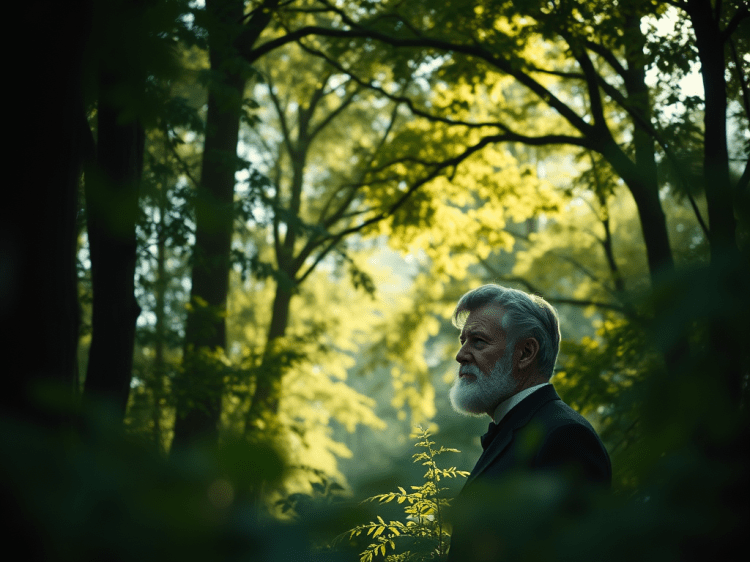
Ralph Waldo Emerson (1803–1882)—philosopher, writer, poet, lecturer, and mystic—was the leading voice of a new current of thought emerging in mid-19th-century America. He spoke clearly to his own generation, and his ideas continue to resonate today. Though the world has changed dramatically since Emerson’s time, his reflections on the individual, nature, and the inner life remain strikingly relevant. His writings have been widely read, quoted, and translated, and his influence continues to be felt across cultures and disciplines.
Emerson was the central figure in New England Transcendentalism—an American expression of a broader philosophical and spiritual movement. Transcendentalism emphasised the underlying unity of all life, the innate goodness and potential of the human being, the primacy of intuition over purely intellectual learning, and the possibility of direct, personal insight into truth. While it drew inspiration from European philosophy and Eastern traditions, it developed in a uniquely American context—among thinkers seeking independence from inherited systems of belief.
An American Expression of a Universal Idea
This transcendental view of life carried a distinctly American tone—practical, open, optimistic, and full of vitality. It encouraged individuals to question assumptions, think for themselves, and cultivate a healthy sense of individuality. Emerson captured something of this spirit in the phrase, “plain living and high thinking.”
Among those associated with the movement were Henry Thoreau, Walt Whitman, Nathaniel Hawthorne, Margaret Fuller, Bronson Alcott, and Theodore Parker—each contributing in their own way to this shared exploration of truth and human potential.
At the heart of Emerson’s philosophy was a deep trust in the individual. He emphasised that each person carries within themselves a source of wisdom and insight. Central to this idea is his concept of the Over-Soul—a unifying spiritual presence in which all beings participate. In this view, distinctions of status or class fall away, for all share in the same spiritual essence. Humanity becomes, in a sense, a great democracy of spirit.
The highest aspect of the self—the intuitive awareness, the “still, small voice within”—is an expression of this deeper unity. Emerson believed that through attunement to this inner dimension, individuals can gain a more profound understanding of themselves and the universe.
Self-Reliance – Inspiration from Within
Yet, Emerson observed that much of humanity remains limited by unexamined beliefs and borrowed opinions. Instead of trusting inner insight, we often defer to external authority—allowing others to shape our thinking and direction in life.
For Emerson, the most valuable quality in a person was what he called the active soul—a living, responsive awareness that engages directly with truth. He encouraged individuals to turn inward, to listen carefully, and to think independently.
As he wrote in Self-Reliance:
“A man should learn to detect and watch that gleam of light which flashes across his mind from within, more than the lustre of the firmament of bards and sages…”
This insight remains as powerful today as it was then: that what we often dismiss as merely “our own thought” may in fact be a genuine expression of deeper truth.
Throughout his life, Emerson sought a fuller understanding of reality. He saw the human being not merely as a physical organism, but as a spiritual presence expressing itself through form. In this light, wisdom arises not only from external study, but from a living connection with one’s inner nature.
Nature, for Emerson, played a vital role in this process. It was not simply a backdrop to human life, but a living teacher—awakening perception, deepening awareness, and guiding us toward insight. Yet he also recognised that this path can feel solitary, for many remain focused primarily on the outer world. As he suggested, we ultimately “live where our thoughts are.”
Nature – Humanity’s Teacher
In his seminal work Nature (1836), Emerson set out his vision in poetic and philosophical language, challenging conventional religious views of his time. Much of his later writing develops the ideas first expressed in this work.
At the beginning of Nature, Emerson reflects on the attitude required to truly perceive and learn:
“The sun illuminates only the eye of the man, but shines into the eye and heart of the child…”
To engage deeply with nature, one must retain a sense of openness and receptivity—a quality of awareness often associated with childhood. When inward and outward perception are in harmony, our relationship with the world becomes more immediate and alive.
Nature invites us to observe—and through observation, to think, reflect, imagine, and create. Emerson suggests that when reason is awakened, perception deepens: appearances become transparent, and we begin to sense the underlying patterns and meanings within them. In such moments, life itself seems to reveal a deeper dimension.
The Creative Mind and the World We Inhabit
Emerson also proposed that our experience of the world is shaped profoundly by our inner life. The way we think, perceive, and imagine influences the reality we inhabit.
Through the creative power of the mind, we bring forth meaning, beauty, and understanding. The artist seeks beauty; the philosopher seeks truth—but ultimately, these aims converge. As Emerson expressed it, truth and beauty are not separate, but reflections of the same underlying reality.
In this sense, human beings are not passive observers of life, but active participants in its unfolding.
The Potential of the Individual
Emerson continually encouraged individuals to aspire toward their highest possibilities. Near the conclusion of Nature, he writes:
“Build therefore your own world. As fast as you conform your life to the pure idea in your mind, that will unfold its great proportions.”
This is not a call to withdraw from reality, but to participate in it more consciously. As we align our lives with our deepest values and insights, our experience of the world begins to change in response.
Emerson’s message remains both simple and profound: that within each person lies a source of wisdom, creativity, and spiritual depth. To recognise and trust this inner dimension is to begin a lifelong journey of discovery—one that leads not only to self-understanding, but to a deeper appreciation of life itself.
 Rosicrucian Online