The Tempest was one of the last plays written by William Shakespeare, yet in the First Folio it appears as the opening work. This placement has long intrigued readers. Some have suggested that the play was placed first not merely for practical reasons, but because it symbolically introduces a deeper theme: the journey of human transformation.
Viewed through a mystical lens, The Tempest can be understood as an allegory of spiritual initiation. The events of the play symbolise the trials, insights, and transformations that accompany the awakening of higher consciousness.
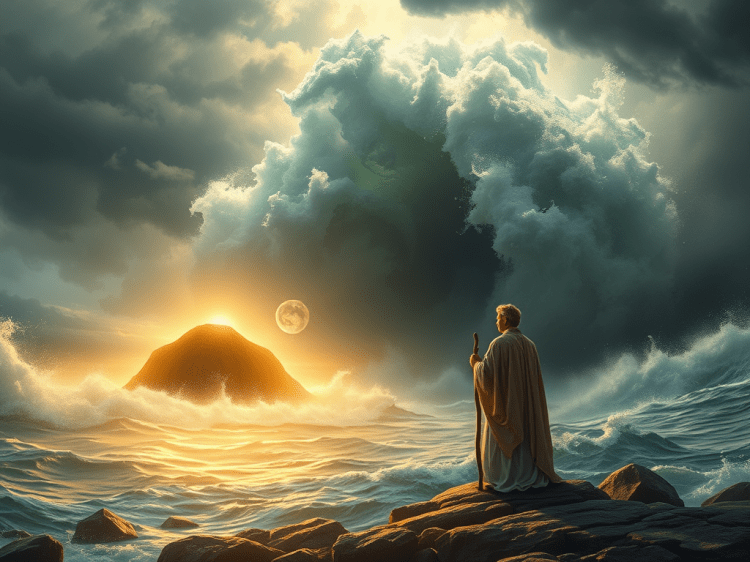
The drama begins with a violent storm at sea. The king’s ship, travelling from Tunis to Naples, is caught in the tempest and wrecked upon a mysterious island in the Mediterranean. This island, however, is more than a geographical setting—it is a symbolic landscape. In mystical traditions, an island often represents a sacred place of initiation, a space removed from the ordinary world where inner transformation can take place.
The tempest itself symbolises the upheaval that precedes spiritual growth. Just as a storm disturbs the sea, so moments of crisis and challenge disturb the calm surface of our lives. Yet such disturbances can lead to what Shakespeare calls a “sea-change”—a profound transformation of understanding.
Prospero and the World of Symbols
At the centre of the play stands Prospero, the rightful Duke of Milan. Twelve years before the events of the drama, his brother Antonio seized power and set Prospero and his young daughter Miranda adrift in an unseaworthy boat. They eventually found refuge on the island, where they have lived ever since.
Prospero embodies the figure of the Renaissance magus—one who has devoted himself to the study of hidden laws of nature and the deeper powers of the mind. His magical robe, staff, and books symbolise knowledge of the occult sciences and mastery over subtle forces.
Shakespeare’s choice of names often carries symbolic meaning. Prospero’s name derives from the Latin prospero, meaning “to cause something to succeed” or “to make prosperous.” Miranda comes from the Latin miror, meaning “to wonder at” or “to marvel.” She represents innocence, wonder, and the receptive soul.
Two other figures on the island also carry symbolic significance. Caliban, whose name resembles an anagram of “cannibal,” represents the raw, instinctual side of human nature—the animal and material aspect of the self. Ariel, by contrast, is a light and airy spirit who symbolises the psychic or spiritual dimension of our being.
Prospero stands between these two forces, directing them through knowledge and discipline. In this sense he represents the conscious will that seeks to harmonise the different elements of human nature.
The Storm and the Purpose of the Trials
The tempest that opens the play is not accidental. It is conjured by Prospero himself. Yet it is not an act of revenge. Instead, it serves a deeper purpose: to bring to the island those who once wronged him, so that each may confront the consequences of their actions.
Among those who arrive are Alonso, the King of Naples, who helped Antonio overthrow Prospero; Alonso’s son Ferdinand; and Antonio himself. They are accompanied by Sebastian, Alonso’s brother, and Gonzalo, a noble counsellor who once showed kindness to Prospero by secretly providing him with food, clothing, and his precious books when he was cast adrift.
Each of these characters participates in what might be called a symbolic initiation.
In Rosicrucian teachings, an initiation is often described as a ceremony—or an experience—that attunes the inner consciousness to higher principles and reveals deeper laws of nature and life. In a broad sense, the entire play functions as such an initiation.
Ferdinand, Alonso’s son, may be seen as the principal initiate. Through trials, discipline, and self-discovery, he undergoes a process of transformation that ultimately leads to union with Miranda.
Trials, Karma, and Self-Realisation
The events of the first four acts can be understood as trials through which each character must confront their past actions. In mystical language, these experiences might be described as the working out of karma.
Some characters show little capacity for growth. Caliban, along with the comic figures Trinculo and Stephano, remains largely bound to instinct and impulse. Antonio and Sebastian represent another level: ambitious and cunning, yet spiritually stagnant.
Alonso and Gonzalo occupy a higher level. Alonso, believing that he has lost his son Ferdinand, comes face to face with the consequences of his past actions and begins to recognise his own guilt. Gonzalo, by contrast, is already characterised by kindness and compassion. Prospero even calls him “holy,” recognising the spiritual quality of his nature.
Above these levels stands Ferdinand, the initiate undergoing transformation. And above him stands Prospero, the magus who understands the deeper pattern of events and guides them toward reconciliation and renewal.
Yet these characters are not only individuals within a story. Symbolically, they may also represent different aspects of the human psyche. Within each of us exist elements like Caliban, Antonio, Gonzalo, and Prospero—the instinctual, the ambitious, the compassionate, and the wise.
The process of initiation involves recognising and harmonising these different aspects of ourselves.
Symbols of Transformation
In one memorable scene, Alonso, Antonio, Sebastian, and Gonzalo hear mysterious music as strange shapes appear bearing a banquet. When the figures vanish, Sebastian remarks in astonishment that he will now believe in wonders such as unicorns and the Phoenix.
These mythical creatures carry symbolic meaning. The unicorn and the lion have long represented the duality within human nature, while the Phoenix symbolises rebirth—the emergence of new life from the ashes of the old. In alchemical terms, it represents the final stage of transformation.
This imagery echoes the broader theme of spiritual regeneration that runs throughout the play.
The Return to the World
The journey depicted in The Tempest is not only one of inward transformation but also of return. Prospero and Miranda originally arrived on the island after being cast out of Milan. By the end of the play, reconciliation has been achieved, and preparations are made for their return.
In mystical traditions, the seeker who attains insight or illumination does not remain withdrawn from the world forever. Like the initiate in Goethe’s Faust or in the alchemical allegories of the Renaissance, the awakened individual must return to ordinary life and apply wisdom in the world.
Prospero himself recognises this truth. His absorption in mystical studies once caused him to neglect his worldly responsibilities, leading to his downfall. Having completed the cycle of experience, he now prepares to resume his role as Duke of Milan.
The union of Ferdinand and Miranda symbolises another stage of integration—the harmonious joining of the outer self and the inner soul. Their marriage will take place not on the isolated island, but in Milan, signifying the bringing of spiritual insight back into everyday life.
The Circle of Initiation
In the final act, Prospero gathers the characters within a magical circle. This circle symbolises wholeness, unity, and protection. It represents a space set apart from the ordinary world—a place where deeper truths may be revealed.
Within this sacred enclosure, reconciliation occurs. Old grievances dissolve, forgiveness replaces vengeance, and a new order is established.
The play ends with Prospero asking the audience to release him with their applause, allowing him to return to Milan. In a symbolic sense, this moment reflects the completion of the initiatory journey: the mystic, having gained understanding, returns to the world to live and serve within it.
A Mystical Allegory
Seen in this light, The Tempest becomes more than a dramatic story. It can be read as a mythic allegory describing the path of inner transformation. Like the ancient mystery dramas of Greece or the symbolic narratives of alchemy, it illustrates the trials, insights, and integration that accompany spiritual awakening.
Whether or not Shakespeare consciously intended such an interpretation, the play resonates deeply with themes found in mystical traditions: the harmony of opposing forces, the discipline of self-mastery, and the ultimate reconciliation of the human soul with the greater order of the universe.
 Rosicrucian Online